Forget Tacos Tuesday — Turkish Kebabs Are Having Their American Moment
Forget Taco Tuesday — Turkish Kebabs Are Having Their American Moment
American food culture moves in waves. One year everyone's obsessed with ramen. Then it's birria tacos. Then Nashville hot chicken takes over every strip mall from Portland to Miami. Right now, if you're paying attention, you can feel something similar starting to happen with Turkish food — and kebabs in particular.
This isn't a fad, though. At least not in the same disposable sense. Turkish kebab culture has roots that go back centuries, and the reason Americans are finally paying attention isn't because some food influencer decided to make it cool. It's because the food is genuinely, undeniably delicious — and it fits almost perfectly into where American dining preferences are heading.
What's Shifting in How Americans Eat
Let's be real: the era of formal sit-down dining as the default "nice night out" is fading fast. What people want now is food that's flavorful and interesting without requiring a reservation three weeks in advance or a dress code. They want to eat something that feels special without the ceremony.
Turkish kebabs occupy exactly that sweet spot. You can eat them standing at a counter in Istanbul, or you can sit down to a full spread with grilled flatbread, mezze, and a glass of something cold. The food scales effortlessly between casual and celebratory, which is a quality Americans increasingly value.
There's also the protein factor. As American diners move away from heavily processed fast food toward meals built around whole proteins and fresh ingredients, kebabs check every box. Grilled meat, fresh herbs, simple sides. It's not complicated, but it's satisfying in a way that a lot of "healthy" food isn't.
Why Turkish Is Different from the Rest of the "Mediterranean" Bucket
Here's something that drives Turkish food lovers a little crazy: the way American menus tend to lump everything from hummus to shawarma to spanakopita under the vague umbrella of "Mediterranean." Yes, Turkey borders the Mediterranean. But Turkish cuisine has its own deeply distinct identity that gets lost when it's treated as interchangeable with Greek or Lebanese food.
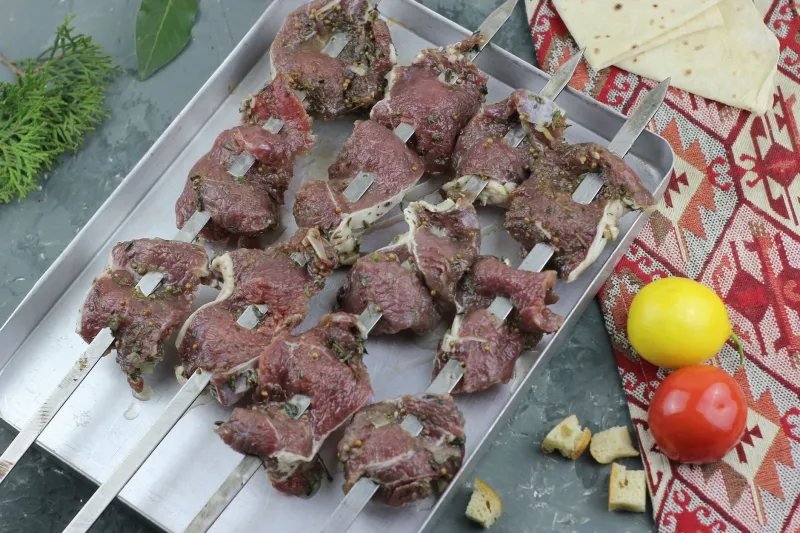
Turkish kebabs, for example, rely on spice profiles that are genuinely different from what you'd find in a Lebanese restaurant. The use of isot pepper, cumin-forward blends, and slow-marinated lamb gives Turkish kebabs a smokier, earthier character. The cooking techniques — particularly the use of charcoal and specific skewering methods — also produce a texture and crust that's hard to replicate with other approaches.
Then there's the bread situation. Turkish flatbread (often called pide or lavash depending on the style) is softer, slightly chewier, and more substantial than a lot of what gets served at generically "Mediterranean" spots. When you wrap a proper Adana kebab in fresh pide with grilled peppers and a smear of yogurt sauce, it's a completely different experience from a pita wrap with falafel.
None of this is to knock other cuisines — there are incredible Greek and Lebanese restaurants all over the US. But Turkish food deserves to be recognized on its own terms, not as a regional footnote.
The Chain Restaurant Problem
As kebabs get more popular, the inevitable has started happening: chains are moving in. You've probably seen them — fast-casual spots with clean branding, digital menu boards, and kebab bowls designed to compete with Chipotle. They're not terrible. But they're also not the real thing.
The issue with scaling kebab culture to a chain model is that the details that make it special — long marinating times, hand-sourced spices, the judgment that comes from an experienced grill cook — are exactly the things that get value-engineered out when you're running 200 locations and optimizing for speed and consistency.
What you end up with is something that looks like a Turkish kebab, hits a few of the same flavor notes, and satisfies a craving in a pinch. But it doesn't tell you anything real about the food or the culture it came from.
This is the gap that places like Taki's Kebab House exist to fill.
From Street Food to Date Night: The Versatility Factor
One of the things that makes Turkish kebab culture so well-suited to the American market is its range. In Turkey, kebabs are eaten everywhere — at roadside stalls, at family restaurants, at upscale ocakbaşı grills where the charcoal is the centerpiece of the dining room. The food adapts to the occasion without losing its identity.
That same flexibility translates beautifully here. A quick weeknight dinner? Come in, grab a wrap and some ayran, and you're out in 20 minutes. A proper date night? Sit down, work through a spread of mezze, share a mixed grill platter, and take your time. Turkish food handles both scenarios without feeling forced in either direction.
We see this play out at Taki's all the time. The lunch crowd is fast and focused — people who know what they want and are back at their desks by 1pm. The dinner crowd is more relaxed, more exploratory. Both groups leave happy, which is honestly the best thing you can say about a restaurant.
Why Authenticity Actually Matters Here
There's a version of this article that could argue authenticity is overrated — that food evolves, that fusion is valid, that a great-tasting kebab is a great-tasting kebab regardless of where it came from. And look, that's not entirely wrong.
But with Turkish kebabs specifically, authenticity matters because the techniques aren't just tradition for tradition's sake. They're functional. The reason you marinate lamb overnight in yogurt and spices is because it genuinely produces a better result. The reason you use charcoal instead of a gas grill is because the smoke is part of the flavor profile. The reason you source isot pepper from southeastern Turkey instead of substituting generic chili flakes is because the flavor is actually different and it actually matters.
When a restaurant cuts those corners, you get a product that's adjacent to the real thing but never quite arrives. And once you've had the real thing, adjacent just doesn't cut it.
The Taki's Take
We started Taki's Kebab House because we believed this neighborhood deserved a genuinely authentic option — not a chain, not a fusion experiment, not a "Mediterranean-inspired concept." Just honest Turkish food made the right way.
The growing American appetite for exactly that kind of food is exciting to watch. People are curious, they're adventurous, and they're increasingly tired of settling for the watered-down version of something great.
If you've been meaning to come in, now's the time. Turkish kebabs are having their moment — and at Taki's, we've been ready for it.